Can you use hair, a blood sample, or a swab?
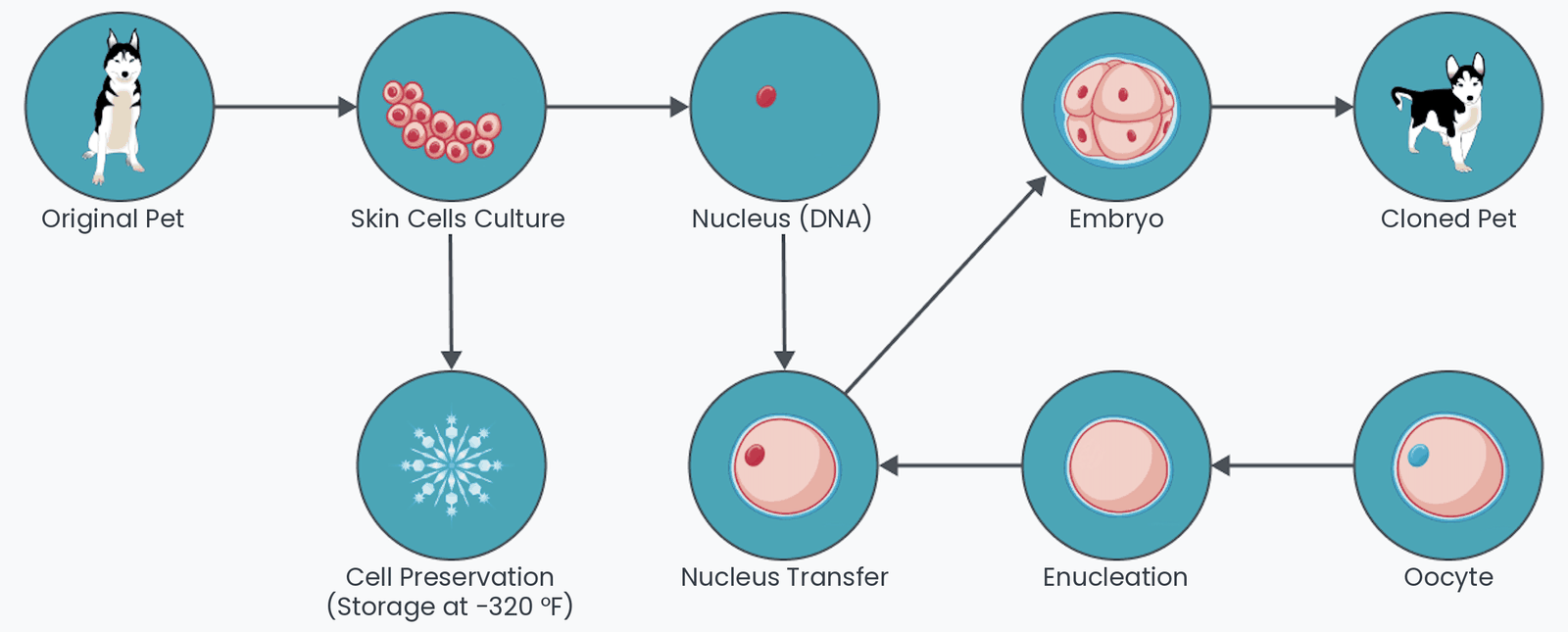
No. Cloning requires living cells, and skin is where we find the right ones. DNA on its own, however well preserved, cannot be used.
How soon after death does the sample need to be taken?
Within about five days, provided the body has been kept refrigerated at around 39 °F the whole time and never frozen. Temperature matters more than the number of days: a body left somewhere warm can lose its living cells much sooner. If your animal has just died, place the body in a refrigerator, not a freezer, and contact us the same day.
How much does it cost to clone a dog or a cat?
$50,000, or $48,000 if the cells are already preserved with us. Preserving the cells first costs $2,000, including one year of storage, and the decision to clone can come years later.
How long can the cells be stored?
Indefinitely. At −320 °F, in liquid nitrogen, cells do not age. Storage is included for the first year, then costs $200 per year.
Will the clone recognize me?
No. It will be meeting you for the first time, as a puppy or kitten. What it will have is the same genome, the same appearance and, in most cases, a temperament its owner recognizes.
Can I clone a pet that died years ago?
Only if living cells were preserved at the time. Skin cells survive for only a few days after death, even when the body is refrigerated, and freezing or burial destroys them. If no sample was taken when your animal died, cloning is unfortunately no longer possible.
What if my vet has never done this?
Most have not, and it is rarely a problem. The biopsy is a routine procedure, and we give you the full written protocol to bring to your appointment. If your vet has questions, they can contact us directly. Occasionally a clinic prefers not to take it on, and another local practice will usually be happy to. As a last resort, tell us and we will try to help.
When is payment due?
Preservation is paid in full before cultivation of the cells begins. Because culture starts as soon as the sample reaches the laboratory, we ask for payment when you decide to go ahead, ideally before the biopsy is taken. For cloning, the payment schedule is set out in writing before you commit.
Where do the surrogate mothers come from, and how are they treated?
Cloning uses a surrogate mother, in the same way human IVF does. The surrogates are usually beagles or cats kept at the breeding facility attached to the cloning laboratory. They are not strays, they are not used up and discarded, and they are cared for through pregnancy and afterwards. As with IVF, more than one embryo is transferred to give the pregnancy a reasonable chance, so occasionally more than one animal is born. You choose the one you take. Any others go to families connected to the laboratory's staff. No animal is destroyed because it was surplus. We will say plainly what we know and what we do not, and we have refused to work with facilities whose standards we were not satisfied with.
Will the cloned animal be healthy, and when does it come home?
Cloned animals are, as far as anyone has been able to measure, ordinary animals. They are not born old, they do not have shortened lives, and they are vaccinated, health-checked and documented like any other puppy or kitten.
They travel to you once vaccination and import rules allow. Under CDC rules, a dog brought into the United States from abroad must be at least six months old, microchipped and registered with the CDC Dog Import Form. Cats follow different rules. We will tell you exactly what applies to your animal before you commit to anything.
How long does cloning take?
It varies enough that any number we published would be misleading. We will give you a realistic range for your case when you reach that decision, based on what is actually happening at the laboratory at the time.
Where does it all happen?
Cell culture and storage take place in our laboratory in the United States. If you would like extra security, a second copy of your cells can be stored in another of our laboratories, as an option. Cloning itself is carried out by our partner
Sinogene, one of the leading pet cloning companies in the world.
Is it legal?
Yes. Pet cloning is legal in the United States, and cloned dogs and cats have been living with American families for years. Preserving your pet's cells is legal too.